Buying Guide Fridges
If you’re looking to buy a new fridge, you want to get value for money with as little stress as possible. Do you know the best place to put your refrigerator in your home, or the difference between a crisper and chiller compartment? If you’re in need of expert advice to get a model that suits you, then read our Fridges buyers guide. From types and styles to noise and efficiency, we’ve packed in all sorts of useful information to make choosing the right model easy.
This guide will help you clue up on the things to look for, the terms you should know, and the features you won’t want to be without. We will help you stay chilled while researching, browsing around the shops, and ordering your perfect fridge.
Contents

Types of Fridges
So, you need a new fridge – what next? First off, it’s essential to understand what kind of fridge you’re after. Different styles vary a lot in terms of size, storage capacity, price, features, and appearance.
Here, we explain the most common types of fridges, from classic freestanding models to contemporary integrated designs.
+ Separate or Combi?
Having a separate fridge and freezer gives you a great deal of flexibility. You’ll be able to choose from a wide range of capacities, rather than settling for the size ratio decided by the manufacturer.
Getting two different appliances also provides you with more freedom over where you place them. This is particularly so with undercounter fridges, which offer lots of storage space while sitting beneath an existing countertop.
Nonetheless, it’s worth considering a fridge freezer too. Combined fridge-on-top appliances can free up floor space, making them ideal if you don’t have the room for two separate appliances. It’s also possible to save on running costs by using a combined appliance. Fridge freezers can, however, be restrictive in terms of positioning – particularly with larger side-by-side designs. For more information, please see our buying guide for fridge freezers.
+ How about a small freezer compartment?
If you’ve decided to buy a separate fridge, it could still contain a small freezer shelf or ice box.
Freezer compartments can be particularly useful if you keep your main freezer in a utility room or garage. This way, small essentials like ice cubes will always be on hand in the kitchen.
A fridge without an ice box is known as a larder fridge. These models maximise refrigeration space and tend to use less electricity, saving money on energy bills.
+ Freestanding or Integrated?
While shopping around for your new fridge, you’re likely to see the words ‘built in’, ‘integrated’ and ‘freestanding’. These refer to whether the appliance is visible, or neatly hidden away behind a cupboard door.
Freestanding
This is the most common type of refrigerator, where the entire appliance is visible. As a result, its design and outward appearance is more important, as it will be on display in the kitchen. You can place a freestanding fridge wherever you have access to a power source.
Freestanding fridges are easy to install, easy to remove if you move house, and easy to access if you ever encounter a problem where an engineer needs to look at the back. They also tend to be cheaper than integrated models.
Integrated
Integrated fridges give your kitchen a more streamlined feel. They are built in alongside your kitchen units, with the appliance hidden behind a cupboard door. While installation can be fiddly, the result is a fabulously sleek finish which retains your kitchen’s original appearance.
Modern cooling technology allows the fridge to work in a confined space without overheating. Because of this, built-in designs tend to more expensive than freestanding ones.
Integrated models often match standard kitchen unit dimensions – around 55-60 cm in width and 55 cm in depth. Fridge doors fix to the unit door in one of two ways:
- Door-on-door – Simply, the two doors are attached and fixed in place.
- Slider – The fridge door slots onto a rail, which fixes onto the inner cupboard door. When opened, the door slides along the track.
+ Undercounter Fridges
An undercounter fridge is designed to fit underneath your kitchen worktops. They usually measure under 82 cm in height, 55-60 cm in width and 55 cm in depth.
They can be built-in or freestanding in design. Sometimes, integrated models are referred to as built under, because of their position under the work surface.
Advantages
Undercounter fridges are easy to fit into most kitchens. They take up minimal wall space and slot in neatly underneath worktops. There is a wide range of models to suit all budgets – including many cheaper ones.
Individuals, couples, and small families may find they don’t need a massive amount of storage space. A size-appropriate undercounter model will save electricity, as you’re not cooling empty space.
Disadvantages
While undercounter fridges vary significantly when it comes to storage space, the volume is usually smaller than a tall design. Fitting in the weekly shop may be a struggle for large families.
+ Tall Fridges
If you have enough wall space, a tall refrigerator is a great choice. These designs commonly measure around 55-60 cm in width, and between 140 cm to 200 cm in height.
They can be built-in or freestanding, although the latter are much more common. A tall fridge will complement a tall freezer well, and some brands offer matching products.
Advantages
Tall fridges generally offer high storage capacities and occupy the same space as an undercounter model, maximising space vertically. If you have space in your kitchen which isn’t obstructed by units, radiators, or windows, a tall fridge is ideal.
Disadvantages
The main disadvantage of buying a tall fridge is the positioning restrictions. Many people find their rooms can’t accommodate such a large appliance. Even when it does fit, a freestanding tall fridge can dominate a space, particularly in smaller kitchens.
Small households may also find a large capacity fridge wasteful as it will use more energy than a smaller model.
+ Wine Coolers
If you consider yourself a wine connoisseur, a cooler will chill your favourite tipple to perfection. It keeps deliciously cool for whites, or at room temperature for reds, even at the height of summer.
Available in undercounter and tall designs, wine coolers often come in sizes and shapes that are different from those of regular fridges. Freestanding and integrated models can be found, often with wooden bottle racks and sleek glass doors.
+ Mini Fridges
Mini fridges are mainly used as a backup or for convenience in a room without a main fridge (such as a bar or bedroom).
They’re also great in a bedsit or student flat where space is severely restricted. Mini fridges and coolers are usually freestanding and portable to make them easy to get upstairs – or wherever else you may need them.
+ Fridge Drawers
Most fridges these days have internal drawers or compartments like salad crispers. However, some modern designs have separate drawers.
This type of fridge consists of one, two, or more refrigerated drawers built into your kitchen units. They can fit in just as much as a regular undercounter fridge, although the different layout might take some time for you to get adjusted. However, they’re great for saving space and creating a modern look.
Another advantage of this style of fridge is that you’re not opening the whole fridge at once. The result is that that the temperature stays constant for longer in other parts of the fridge, although the small individual compartments may make it tricky to store larger items.
+ Colours and Finishes
If you’re buying a freestanding refrigerator, its appearance is particularly significant.
Clean white designs are common, thanks to their ability to blend in with a kitchen easily.
For a more contemporary look, silver or black finishes can match other details in the room. At the upper end of the market, stainless steel designs provide an industrial, professional kitchen feel. Some brands also offer bright colours and quirky designs.
Size and Capacities
When it comes to buying a fridge, the numbers matter. How much space do you have available in your kitchen, and what capacity do you need to store your family’s food? This section will help make things a little clearer for anyone who finds themselves confused by gross and net capacities, sizes, and dimensions.
+ Fridge Capacities
A fridge’s capacity is the amount of internal space it has for storing food – usually given in litres.
Confusingly though, a model which is larger on the outside doesn’t necessarily have more storage space inside. That’s why it’s important to look at the capacity listed in the specification.
Gross and net capacity are different, so make sure you’re comparing like for like. Gross volume is the total space in the compartment, while net capacity is the usable space, having deducted the room taken up by things like fixed components and shelving.
+ Choosing a Suitable Capacity
Bigger doesn’t always mean better. Running a fridge half empty can waste energy, so try to select a size that’s suited to your household needs. A standard undercounter model will likely have a net volume of 90 to 150 litres, while a taller design can be anywhere between 200 litres for a smaller model, up to around 400 litres for the largest.
Wine coolers tend to be measured by how many bottles they accommodate, but there will usually be a measurement in litres on the specification too.
How much you can store also depends on the shelving arrangement. You’ll never fill every shelf or drawer to the top, so the number of compartments and storage areas matters too.
+ External Dimensions
“What size fridge should I buy” is a common question, and it’s important to check the external dimensions before you make your purchase. Fridges usually come in at around 55 to 60 cm wide, while depth can vary anywhere between 50 cm to 65 cm deep, typically.
The height will depend on the style you’ve chosen – undercounter models measure a standard 82 cm high so they can slot in underneath the kitchen worktops. Tall models – as the name implies – are taller. The biggest ones are around 185 cm high, although there are smaller models around 145 cm available too.
If you have a narrow hallway or door frame, it might be worth measuring that too. You don’t want to buy the perfect fridge but struggle to get it inside the house. Remember that you’ll need to allow a little extra room around the back, top, and sides, so that the air can circulate.
+ Left or Right-Hand Opening
With factors like size to consider, it can be easy to overlook the door. Choose a door which opens the right way, so it doesn’t clash with your kitchen units. The fridge’s specifications should list the door’s opening side. Some are even reversible for extra flexibility.
Fridge Storage
We all know the capacity of a fridge is essential. But how many people consider the type of storage on offer before making a purchase?
We explain the different ways manufacturers organise the space so that you can make life a little more comfortable with the perfect combination of drawers, compartments, shelves, bottle racks and salad crispers.
+ Fridge Shelves
The number of fridge shelves varies between models. Generally, undercounter designs have around three, while tall larder fridges can have as many as six. Look at the specifications while you’re shopping around.
Most models also have a salad crisper. Sometimes the top of this is counted as a shelf, but sometimes it isn’t. Look at pictures of the interior where possible so you can be sure how many shelves there are.
+ Shelving Features
In many fridges, the shelves are adjustable, giving you the opportunity to tweak the storage space to accommodate large and awkward items – for example, a birthday cake or Christmas turkey. The shelves are likely to be transparent, either made from safety glass or plastic. Clear shelves help the light flood the entire storage space so that you can see everything easily.
Spill-proof shelves have a raised lip around their edges. If liquid leaks onto the shelf, it won’t be able to drip down onto the shelves below, protecting other food from damage. These shelves also make cleaning up the mess easier.
A split shelf divides the width of the fridge into two separate shelves. You can position the shelves higher and lower than each other, independently, which gives you extra flexibility when storing taller items.
+ Door Racks
Door racks are a common feature in most fridges. These handy compartments are ideal for keeping bottles of fresh juice upright, as well as small items like condiments and preserves, which can become lost on the main shelves.
Bottle grips keep tall items upright, while a lidded compartment will maintain a colder temperature, even when the door is open. These are ideal for storing your butter and margarine.
An egg tray can often be found inside the fridge door too. Recycle the box and keep your eggs neat and secure.
+ Salad Crisper/Drawers
An enclosed drawer at the bottom of a fridge is called a salad crisper. This special drawer helps you keep certain fruits and vegetables fresher for longer by controlling moisture levels and air circulation.
Most fridges have one of these bins, while others have two so you can sort items by type. Some high-end models even have adjustable humidity levels in this compartment, for the perfect storage environment.
You might also find chiller compartments, which are like salad crispers but intended for keeping meat and fish fresh at around 0°C.
+ Bottle Racks
Always found alongside your shelves, a wire bottle rack provides horizontal storage for bottles of wine and fizzy drinks.
It will safely hold them in their place and is a handy addition for anyone who loves a chilled drink.
+ Freezer Compartment
Some fridges have a freezer compartment or icebox. Usually, a compartment with a drop-down flap on the front. It’s ideal for storing essentials and quick meals close to hand.
However, this may not store items for very long and is unlikely to be suitable for freezing fresh food.
Fridge Features
Once you’ve decided on the type and size you’re after, it can be difficult to know what else to look for in a fridge. Features are one of the main factors which set a budget-buy apart from a top-of-the-range model.
When it comes to fridges, the small details make a big difference. Clever features like reversible doors and auto- defrost make life a little easier, while intelligent modes and smart cooling systems ensure your food is always kept at its best.
+ Auto-Defrost
Auto-defrost is a fantastic time saver, so it’s no surprise that it’s one of the most sought-after features when buying a fridge.
Fridges naturally produce condensation as part of the cooling process. Unfortunately, this can turn into ice on the back wall of your fridge, preventing the appliance from running as efficiently as it could.
Auto-defrost makes this problem a thing of the past. By heating the cooling element every now and again, frost is melted away, before being drained away through the back of the fridge. You’ll never need to defrost it manually, saving you time and plenty of effort.
Most models have this feature, but not all – it’s worth keeping an eye out for it.
+ Cooling Systems
Traditionally, fridges use static cooling systems to keep items cold. The cooled air moves by convection, with warm air rising and cool air sinking to the bottom.
Modern dynamic cooling systems use a fan to encourage better ventilation. Different parts of the fridge stay at the same temperature, and food stays fresher for longer. Dynamic cooling tends to be limited to more high-end models.
Another feature to look out for is a concealed evaporator – this will save space, leaving you more room for food.
+ Controls and Display Panels
Some fridges have manual controls – usually a dial which you twist to set the temperature. Others offer more precision with a digital thermostat.
You may find basic operating buttons and lights on manual models, such as a power-on light. Digitally controlled fridges tend to have an electronic control panel. Sometimes these include lights to show which modes are in operation, as well as lights or alarms which alert you if the door is left open.
+ Helpful Modes
Ever thought about how much you’re paying to run your fridge while you’re away? If you’d like to save on bills while you’re abroad, choose a refrigerator with a holiday mode.
This mode will run the appliance with minimal electricity consumption as you won’t be opening the door and letting in any warm air.
A quick cool function is another handy detail. It’ll chill your items rapidly, preserving nutrients and flavours more effectively.
+ Lighting
You may think that all fridge lights are equal, but this is not necessarily the case. In the past, conventional light bulbs were used, which had a tendency to get hot and made it harder for the fridge to maintain an even and cool temperature.
The introduction of halogen lighting meant fridge interiors were brighter, making it easier to find even the smallest items hidden at the back. These bulbs are energy efficient and have a long lifespan of 2,000 to 4,000 hours.
Top-of-the-range fridges benefit from the latest LED lighting. LEDs get bright instantly and remain cool to the touch, keeping the fridge interior cold. Their advertised lifespan is even longer than halogen bulbs – up to a remarkable 50,000 hours.
+ Antibacterial Coatings
Many brands are using antibacterial components to help you maintain a healthy storage space.
Special door seals prevent the harmful bacteria outside from getting to your food, while coatings inside make everything more sanitary. Some models even have antibacterial door handles to protect the most-touched part of the fridge.
+ Fitting
Clever design features help you integrate your new fridge into your home with ease.
Adjustable feet mean uneven floors are no longer an issue. Likewise, a reversible door means you don’t have to worry about it knocking into your kitchen door or cupboards, and gives you freedom over where you place your appliance.
+ Water Dispenser
Some high-end fridges have a water dispenser in the front of the door, for chilled drinks on demand. You’ll find this feature more often on tall fridges than undercounter models, but even then, it’s relatively rare. If a water and ice dispenser is an essential feature for you, consider a combi fridge freezer instead – you’ll find a wider variety of models with this feature.
Water dispensers come in plumbed and unplumbed varieties. Plumbed variants are connected to your mains water, while non- plumbed versions have a container you’ll need to keep topped up.
+ Smart Technology
The latest trend in home appliances, smart technology keeps your kitchen connected.
Smart fridge features vary depending on the brand and model. They include syncing grocery lists with your smartphone, looking up and reading out recipes whilst you cook, and internal cameras you can view remotely so that you know if you’re low on the essentials.
All of this is very cutting edge, and you can expect to pay more for features like these. However, as smart technology becomes more prevalent over time, prices will likely become more affordable.
Wine Coolers
Storing wine isn’t difficult, but if you want to retain its flavour, colour, and complexity, there are some things to keep in mind. Subtle changes in temperature, humidity, UV light levels – even vibrations – all impact what’s happening inside the bottle.
A wine cooler will make sure everything is as it should be to keep your wine at its best.
As well as keeping your wine safe, these fridges add a luxurious quality to a room and are the perfect way to show off a prized collection. Wine fridges are a little different to a standard refrigerator, so we’ve included lots of information here to help you choose.
+ Built-In or Freestanding?
A built-in wine cooler gives a streamlined look to your kitchen.
They’re sometimes described as integrated since they’re fitted in alongside your cupboards. This helps add a touch of elegance to your kitchen, as it looks like it was designed to be a part of it. Built-in wine fridges usually have vents on the front, allowing the back and sides to be enclosed without causing the appliance to overheat.
Freestanding designs can be placed anywhere with a power source. Fitting is much simpler, although these models tend to have vents at the back, so you’ll need to leave a gap between the cooler and the wall to let air circulate.
+ Different Cooling Systems
Wine cabinets work in one of two ways. They either have a compressor, like your main refrigerator, or they’re thermoelectric. Thermoelectric models use a small ‘heat pump’ with no moving parts, fluid, or refrigerants. Both types have advantages and disadvantages.
While compressor models can get to lower temperatures and handle higher room temperatures well, they are often a more expensive and louder option.
Thermoelectric units are easier to install, quiet, and efficient. They’re perfect for keeping in your main living area. However, they might not perform as well in an unusually warm room.
Either system can benefit from no-frost technology. This prevents ice from building up, keeping the cooler running efficiently.
+ Capacities
These appliances vary hugely in size, so think about how much wine you’re planning to store.
Slimline models can fit six or seven bottles in without encroaching too much on your kitchen space. Restaurant-style freestanding ones can hold more than 100 at a time. Undercounter coolers, designed to fit underneath your kitchen worktops, rest somewhere in between, with space for around 30 to 40 bottles, typically.
It’s also worth considering which wines you drink the most. Most coolers have shelving designed for standard Bordeaux style bottles. Some wines such as champagne or pinot noir have a wider, shorter bottle shape. You’ll need to check the racking can hold them securely. If you’ve got a mixed collection of bottle shapes – and the likelihood is that you will – you should expect to fit about 70% of the stated capacity.
+ Temperature Ratings
You’ll probably know that white wine should be kept cooler than red. But did you know connoisseurs recommend specific temperatures for different wines?
Generally speaking, the fuller bodied the red wine, the warmer it should be kept. This means the range can be anywhere between 12˚C and 19˚C. Chill sparkling and sweet white wines to a cooler temperature than dry whites like Sauvignon Blanc.
Recommendations for these spans from 5˚C to 12˚C. Wine coolers let you control the temperature of your wine to get it perfect. Some models have separate zones for reds and whites, with independent temperature controls for each of the different areas.
Even if you have only one cooling zone, you’re likely to be able to set an exact degree of cooling for the perfect glass, straight out of the fridge.
+ Humidity Andventilation
State-of-the-art wine coolers take care not only of temperatures, but of humidity and ventilation too. The humidity level where you store your wine is significant. Moisture prevents the cork from drying out, although too much of it could cause mould. A good ventilation system will keep the wine cold even after you’ve opened the door. It’ll also get rid of any odours which could tarnish the flavours inside each bottle. Some chillers also have fans which move air around the storage space, effectively maintaining a constant and even temperature.
+ UV Protection
Believe it or not, sunlight can damage your wine. Exposure to UV rays destroys the tannins in the wine, altering the colour and flavour.
While keeping bottles out of direct sunlight can help, the latest wine coolers have glass doors with built-in UV protection. That means you have one less thing to worry about when choosing where to put your new wine cooler.
+ Anti-Vibration
Another factor that affects wine is vibration. While sediments naturally settle to the bottom of a bottle as it ages, slight movements can disrupt the process.
Anti-vibration features prevent this from happening, helping your bottles age naturally.
+ Energy Ratings
Since you’ll use your new wine cabinet for long-term storage, you’ll need to choose an efficient model to avoid nasty surprises on the energy bills.
Most retailers provide details of annual energy usage or running costs, making it easy to compare different models.
Wine coolers use a different energy labelling system to regular fridges and freezers. Don’t be alarmed by a low energy rating (rather than the A+++, A++ or A+ we often see in other appliances). Their glass doors make them less efficient than ordinary fridges, but the running costs tend only to be around £30 a year.
+ Extra Features
Manufacturers often add additional features to make looking after your wine even more convenient.
+ Double Glazed Doors
Both freestanding and built-in models tend to have glass doors which display your bottles to their full potential. Double glazing helps to insulate the cabinet to ensure you don’t lose the temperature you want.
+ Shelving
Most wine coolers have traditional wooden shelves which provide beautiful contrast against a stainless-steel exterior.
Others have sleek chrome shelves for a contemporary look. Horizontal shelving prevents the cork from drying out and letting air into the bottle.
Entry-level models often have fixed shelving, while more expensive ones have adjustable systems to accommodate different sized bottles. Keep an eye out for sliding shelves too – these let you read the labels more easily.
+ Interior Lights
Make it easier to see your collection by choosing a wine chiller with a built-in light. Many designs use LEDs for bright illumination without any heat.
+ Controls and Displays
Touch button controls and digital displays make it easy to set the chiller to the exact temperature your wine needs.
+ Warning Alarm
If there’s ever a problem, you’ll want to know about it. High spec models use built-in warning alarms to alert you if the temperature or humidity reaches levels which could spoil your wine.
+ Reversible Door
Choosing a chiller with a reversible door gives you a little more freedom when fitting. You’ll be able to decide whether you want a left or right-hand opening, making it easy to avoid bumps with kitchen cupboard doors or furniture.
+ Ambient Temperatures
While most wine fridges can adapt to room temperature changes well, fluctuations do mean the cooling system has to work harder. Where possible, try to keep yours in a room with a consistent temperature, such as a living area or kitchen. If you have a cellar or garage in mind, look for a model which advertises this in its specification. Not all are suitable for low ambient temperatures.
Energy Efficiency
Getting a great fridge for a perfect price is all well and good, but what about the costs long term? By thinking about energy efficiency, you’ll be able to save money in running costs and do your bit for the environment.
+ Average Running Costs
Your fridge is one of the few energy-consuming appliances in the home which is left on continuously. As a result, cooling appliances like fridges have been found to be the most energy-hungry items, using up to a third of your overall power use.
However, the average running cost of a fridge is a surprisingly reasonable £25 per year. New models are more energy efficient than ever before, despite the average size of refrigerators growing larger.
If your current fridge is over ten years old, consider buying a replacement even if it’s still working. New designs have better insulation than older ones, as well as defrost features and high-efficiency compressors, which all work to save electricity. The money you save on your electricity bills over the years might even cover the initial upfront cost.
While new fridges are undoubtedly more efficient than older ones, there’s still variation between different models on the market. Annual running costs can vary from £12 to £38 per year, which makes a big difference over an appliance’s lifespan. You can compare running costs by looking at each fridge’s yearly energy consumption in its specifications – measured in kWh/year.
+ Energy Ratings
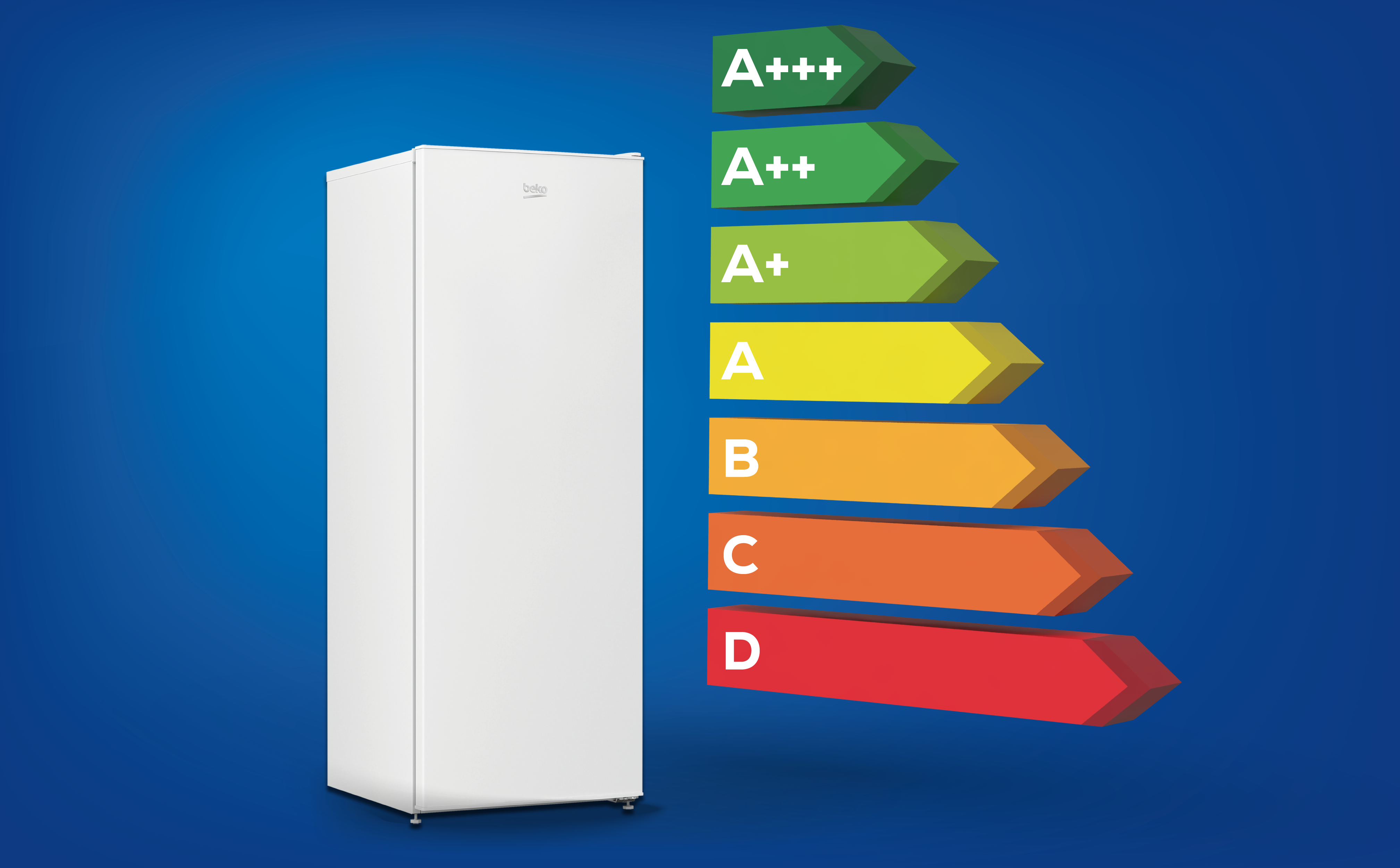
Freezers are one of the few appliances that are on all the time, so it’s important to get an energy efficient model. This makes a difference to your utility bills and reduces your impact on the environment.
But which models are the most efficient, and which cost a little more to run? Scroll down to find out more.
+ Beyond The Rating
Of course, there are other aspects to consider regarding energy efficiency – that go beyond the letter rating.
For instance, two different sized fridges with A ratings could have very different running costs, as a bigger appliance will normally require more energy. Buying the right size appliance to suit your demands will help improve your energy costs.
+ Fridge Size
A fridge’s energy rating considers its storage capacity. That’s another reason why the kWh/ year statistics may be worth a look, and why size is an essential factor to consider when buying a fridge.
Carefully consider how much food you’ll need to store. A 100 or 200 litre fridge will be adequate for most couples, while families of four might find a 250 to 300 litre model ideal. Running a half-empty fridge will often waste electricity.
In contrast, the air will struggle to circulate if there’s not enough space around your food for it to do so. As a result, your appliance will have to work harder to keep everything cool. For these reasons, it’s best to try and find a balance when choosing the size of your fridge.
+ Environmentally Friendly Features
Auto Defrost
Condensation in a fridge can turn into ice build-up on the back wall. Ice significantly affects how well your appliance works, to the extent that some items might perish more quickly. Auto defrost uses a careful combination of warming and cooling to melt frost and rain it away. Doing so means you can relax knowing your fridge is always running efficiently.
Holiday Mode
This handy feature will save energy while your fridge isn’t in use. It’ll keep the interior at a slightly higher temperature than usual, while still being cool enough to prevent the formation of odours and mould. Different appliances run this mode at different temperatures. Some are cold enough to keep some perishable foods stored safely until your return.
Extra Tips
As well as choosing an environmentally friendly model, there are little things you can do to help your fridge run more efficiently.
Optimum Temperature - It’s recommended you keep your fridge at 4°C. Any colder and it’ll be using more electricity than necessary.
Leftovers - Check any hot food is cool be- fore putting it inside. Adding warm or hot items into the fridge raises the temperature, potentially causing bacterial growth. It also means your fridge will have to work harder to get cool again.
Shut the Door - It seems obvious, but we can all be prone to leaving the fridge door open. Try to remember to close it – even if you’re just quickly pouring some milk on your cereal.
Air Circulation - When fitting your fridge, leave a couple of centimetres around the back and sides. Doing so improves air circulation, helping the cooling system run efficiently.
Maintenance - The back of your fridge can be a dust magnet. This build-up will increase energy consumption, so take a few minutes to clean it every now and again.
It’s also worth checking the door seals – cracks can let in warm air.
+ Energy Efficiency VS. Price
Expect to pay a little more for an economical appliance.
While the initial cost can be off-putting, remember to consider the annual savings you’ll make on running costs. If you’re saving £25 a year on your electricity bills, this adds up to £300 over a fridge’s average 13-year lifespan.
Installation, Disposal and Location
Ordering a fridge is only half the story. Once you’ve found the perfect model, you’ll need to think about finding a location for it in your home, installing it, and disposing of your old one.
Sometimes it’s easiest to do all this yourself, but it can be better to pay a little extra and ask the supplier to sort everything out for you.
Transportation
It is possible to move your new fridge yourself, but most retailers offer this service to save you the hassle. During transport, it should always remain upright, which can be difficult if you don’t have access to a large vehicle.
Keeping a refrigerator upright is vital. The compressor has oil in it and resting it horizontally causes the oil to flow into the cooling pipes. If the fridge is switched on before the oil has settled into the compressor, it can take lasting damage. The same rule applies if you are moving house with an older fridge.
Bear in mind that fridges can be heavy, too. You’ll probably need a sack barrow and two people to move it safely.
Installation
Navigating doors and hallways with such a large item isn’t easy but measuring up before making a purchase should mean it isn’t too much of a problem.
Once your fridge is in the right place, getting it up and running is simple. Firstly, you’ll need to wait for everything to settle. Wait at least an hour before plugging it in. If you decided to risk transporting it horizontally, it’s likely that you will need to wait four hours or more.
In the meantime, remove all packaging and clean all the shelves and compartments with water and a little washing up liquid.
The outside will need a quick clean too.
With any fridge, ventilation is critical. That means you should leave a 2 cm gap around the back, top, and sides to let the warm air escape. This advice even applies to integrated designs. Some models will require more space, so it’s always worth checking the product manual.
Once the fridge has been left to settle for the recommended amount of time, you can switch it on. All these instructions can vary between models though, so make sure you read the manufacturer’s guidelines too. Often, after plugging in your new fridge, you’ll need to set the temperature to a certain level and wait before storing your food.
+ Integrated or Built-In Models
Integrated fridges are a little more complicated, and you’ll probably need help from an engineer. Taking out an old integrated fridge requires the panel door and ventilation plinth to be removed, and unplugging it is tricky too. The new one will then need the cupboard door attaching and the plinth replacing.
Location
Most people will keep their new fridge in the kitchen, often in the same spot as their old one.
Other times, the new appliance will be used for additional storage and kept in the garage or the basement. The location has a huge impact, so it’s essential to pick the right model for the job.
+ Style
If you’re not sure which fridge will fit your space, look at our explanation of styles and types. An undercounter model will slot under your kitchen counter, while a tall model is ideal if you have room for one.
+ Inside or Out?
It seems strange for a chilled appliance, but some external temperatures are just too cold for a fridge.
Most people keep theirs in the kitchen, so this isn’t too much of an issue. If it’s going to be a second fridge and you want to keep it in the garage or basement, you’ll need to look at the appliance’s Climate Class rating.
“N” (Normal) and “SN” (Sub Normal) temperatures are the two categories most relevant in the UK. A fridge marked “N” can operate in temperatures ranging from 16°C to 32°C, while “SN” means it is guaranteed to work between 10°C and 32°C. Anything outside of these temperatures may cause the fridge to stop working correctly, damaging your food.
As the lowest external temperature is 10°C, it might not be possible to keep a fridge in an unheated garage where temperatures can reach freezing point. Some fridge freezers and freezers have advanced technology that allows them to work at temperatures as low as -15°C, but this feature is very unusual for a fridge. Check the manufacturer’s recommendations.
+ Away From Heat
Keep your fridge away from heat sources like radiators, ovens, and direct sunlight. Doing so means your appliance won’t need to work as hard to keep your food cold.
Disposal
Most retailers offer a disposal service for a more straightforward switch from old to new.
Legal restrictions mean you must dispose of a fridge in a way which meets standards set by legislation designed to protect the environment. For example, ozone-depleting substances must be removed before the fridge is thrown away.
You could take the fridge to an appropriate recycling centre yourself, but it’s often easier to let professionals deal with it. The most convenient way is to organise for the people who deliver your new fridge to take the old one. Most councils will collect large items too – either way, there is usually a small fee.
Fridge Prices
If you’re shopping around for a new fridge, you’ll want the best model for your budget. This section offers handy tips on finding a great appliance at a great price. Learn more about what to expect in your price range, plus ways to get a better deal.
+ What's your budget?
Consider how much you want to spend before comparing different models.
The cheapest fridges will keep your food cold, which is all most people require.
However, more expensive models offer modern designs, special features, the trusted reputation of a well-known brand, and high energy efficiency ratings.
+ Entry Level
You can buy a bare-bones larder fridge for between £100 and £150. These models will be basic, but you should still be able to find brands you recognise.
Features will be quite similar on these models, with salad crispers and A+ energy ratings being standard. Capacities will be on the low side, but that’s not necessarily a bad thing for small households. Some features might be lacking, such as dynamic cooling and door open alarms.
You’re also likely to find yourself limited to freestanding undercounter designs. Tall and integrated models tend to be a little more expensive.
+ Mid-range
Budgeting a mid-range of £150 up to £400 gives you a much wider choice of fridges, with freestanding and built-in versions of both undercounter and tall models. There’s a bigger range of features on offer too, including auto defrost, special modes, ice boxes, larger capacities, and higher energy efficiency ratings.
The details vary, so compare models to make sure you get every feature you need.
+ Top-of-the-range
Since you’ll probably have your fridge for ten years or more, you may find yourself happy to invest more than £350. At this price, you can expect top brands with more features and modes, huge capacities, and cleverly organised storage.
At £800 and over, you’ll be able to treat yourself to a sleek stainless-steel tall fridge, complete with a water dispenser in the door, as well as brightly coloured retro de- signs which make a statement.
More expensive models offer modern integrated designs, special features, the reputation of a well-known brand and high energy efficiency ratings.
+ Extra Costs
When budgeting, remember that it’s not just the purchase of the fridge you’ll need to consider.
What might seem like a great deal at the time can become less attractive once you factor in the extras. Here’s what to look out for:
Delivery and Disposal
Most retailers charge for delivery and disposal of your old appliance. This varies between suppliers, so add these on to the fridge cost to get an overall price.
Remember, an integrated fridge is a lot harder to fit, so you’ll probably want to leave that to the professionals.
If you’re choosing a freestanding design, you could save money by setting it up yourself.
Running Costs
While one fridge may be more expensive initially, if it’s energy efficient, it could save you money in the long run. Look at annual running costs and consider them before making a purchase.
Guarantees
An extended guarantee can save you a fortune if anything goes wrong. Some manufacturers offer two, three, or even five-year parts and labour guarantees for peace of mind.
Sales and Deals
If you don’t need a new fridge urgently, you could wait for a promotion or deal.
Cashback, trade-in discounts, and sales help you get the best value fridge for your money.
Online Reviews
Unsure whether that high spec model is worth the extra money?
Look at online reviews. While it’s important to take them with a pinch of salt, they should be able to give you an indication of how good an appliance is.
Buying Guide - Fridges
Want to view our full buyers guides range? Click here.
Find your local store here.
Phone 01264 320504 - Mon - Fri 9am – 4.30pm
Order enquiries - [email protected]
Customer support - [email protected]
Euronics Limited
Euro House, Joule Road, West Portway Andover, Hampshire, SP10 3GD www.euronics.co.uk